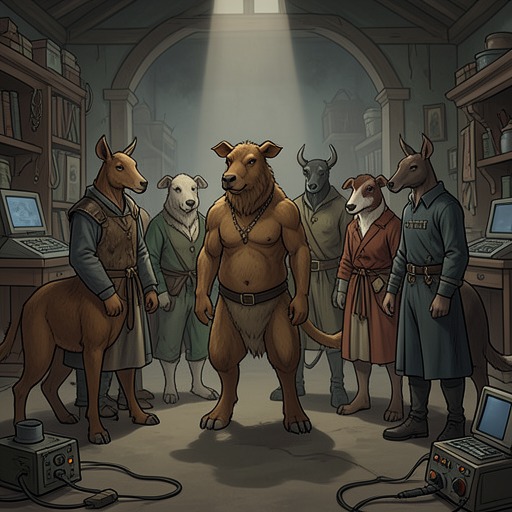
Bell to Be Tied Around the Cat
Aesop's FablesThe Bell to Be Tied Around the Cat is the proposed warning device in a council of Mice seeking protection from their enemy, the Cat. By making the Cat’s approach audible, the bell would give the Mice time to retreat into their holes; but the plan reaches an impasse when no one will undertake the dangerous task of attaching it. Its force lies in the contrast between collective ingenuity and the personal risk required to put an idea into practice.
The Council’s Problem
The Mice call a council to consider how they might warn themselves of the Cat’s approach. Their concern is practical: advance notice would let them run to safety and hide in their holes. The bell answers that need by turning the Cat’s movement into a warning the Mice can hear.
How the Bell Would Work
The favored proposal is to tie a bell around the Cat’s neck. Its tinkling would announce the Cat’s approach, converting a threat that the Mice need to anticipate into a signal they could use. The scheme depends on more than the bell itself: someone must get close enough to attach it to the very enemy whose approach the device is meant to reveal.
The Unresolved Task
The proposal wins support among the Mice, but agreement on its usefulness does not produce a volunteer. When the council asks who will bell the Cat, no one is found willing to do it. The story ends at that gap between proposal and execution: the warning device remains an idea, and the Mice’s original problem has not been solved.
Meaning and Fable Form
The bell makes the difference between imagining a remedy and carrying it out into the center of the episode. Its comic economy depends on a simple reversal: the plan requires one Mouse to approach the danger in order to protect all the others from it. In the preface, the fable is described as a short narrative whose instruction is woven into its action and whose fictitious characters allow it to teach indirectly. This episode exemplifies that structure: the council’s stalled scheme lets readers infer the limits of a plan that has no willing executor, without a separate moral being stated in the story.